 Top Trending
Each Squeeze of This Oregon Bottle Is Made From 91 Milligrams of Dried Herb
Half a teaspoon of sage holds more. Here's what a squeeze of Herb Pharm's five-herb Brain & Memory is made from, what the trials used, and what customers said.

This is a paid advertisement. Sponsored by Herb Pharm, LLC.
Samuel Boyd is the pen name of this desk.
The customers quoted on this page are real; their reviews are public on the seller's site and were read through the seller's own review system on September 5, 2026, and checked again on September 6.
I haven't met them and know nothing about them beyond what they wrote. The small photos beside their reviews are illustrations, not the reviewers.
Everything about the bottle, from the label to the return policy, comes from the seller's own pages, read the same days.
I keep a notebook for bottles like this one.
Not a diary. A page of numbers, written down before I let myself have an opinion.
The label's numbers first. Then the trials' numbers.
Then what the customers said, in their own words.
When the three columns agree, I buy the thing. When they don't, I tell you where they part ways.
This bottle gave me the smallest number I've written down in a while, and it's printed right on the label, where almost nobody reads.
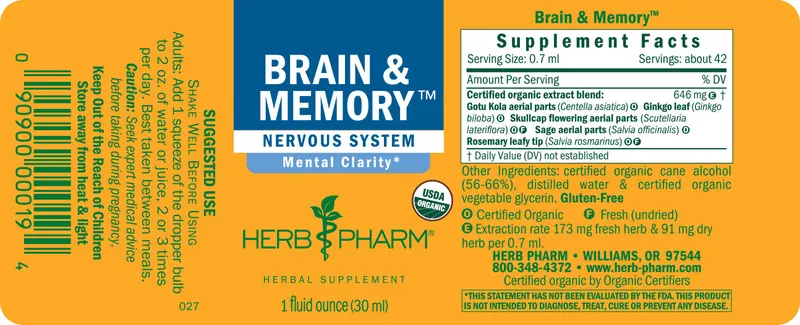
"Extraction rate: 173 mg fresh herb and 91 mg dry herb per 0.7 ml."
That's the line.
It says how much plant each squeeze was made from.
Ninety-one milligrams of dried herb, for the whole squeeze, for all five plants together.
Now walk to your spice rack and take down the sage.
A level teaspoon of ground sage weighs seven tenths of a gram, according to the government's own food tables. [1]
Half a teaspoon is 350 milligrams.
Three squeezes a day, the label's maximum, are made from 273 milligrams of dried herb, shared by five plants.
Half a teaspoon from the sage jar holds more.
I'm telling you this first because it decides how to read everything else about this bottle.
Not with suspicion. With a pencil.
Here's what the bottle is.
One fluid ounce of dark liquid in an amber glass bottle with a black rubber bulb, from a company in southern Oregon that's been making herb extracts since the late 1970s.
Five plants, all certified organic, in cane alcohol, water and a little glycerin.
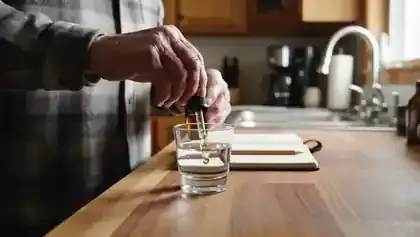
You squeeze the bulb once into two ounces of water or juice, two or three times a day, between meals.
About 42 squeezes to a bottle, so two weeks at three a day.
That's the whole product. No capsules, no scoop, nothing to swallow dry.
It tastes, by every account, like what it is: herbs in alcohol, bitter and green, softened by the water.
I did what I always do.
I read the label before the listing.
I read the trials behind each of the five plants, at the doses they actually used.
I read all 23 reviews, and I'll tell you which ones I kept and why.
And I read the shipping page and the return page, which are kinder here than most.
What I found is a real bottle of real herbs at kitchen amounts, sold by honest people, that does less than its name and more than nothing.
The Name That Won't Come, and the Room You Walked Into for Nothing
Before the bottle, let's talk about you for a minute.
Because you didn't land on a page about five herbs by accident.
You know the moment.
You're telling a story about a fellow you worked with for twenty years, and his name just isn't there.
You can see his face. You can see his truck.
You know it starts with a B, or maybe a D.
And an hour later, while you're rinsing a coffee cup, it drops in: Dale. Of course it was Dale.

Or it's the paragraph.
You read it, you get to the bottom, and you realize you've no idea what it said.
So you read it again, slower, with your finger on the line.
Or it's the reading glasses.
You've been looking for them for five minutes, and they've been on top of your head the whole time.
Why does this happen more now than it did at forty?
Partly because there's more in the drawer.
Sixty-odd years of names, faces, phone numbers and parts numbers, and the drawer doesn't get any bigger.
Partly because life got quieter.
Fewer meetings, fewer deadlines, fewer people asking you to keep ten things straight before lunch.
Or it's the hallway.
You walk into the garage with a purpose, and by the time you're standing by the workbench, the purpose has gone back inside without you.
Is that something to lose sleep over?
Not on its own.
Everybody past fifty has a pantry story, and most of them are funny by dinner.
But it's annoying.
It's annoying at the hardware store, at the grandkid's ball game, at the table when your wife says, "You know, the one with the boat."
That small, ordinary annoyance is the whole subject of this page. Nothing bigger.
If you're here for something bigger, the right person is your own clinician, and I'll say that again near the end.
A name on the tip of your tongue is a nuisance, not a verdict.
Why Another Cup of Coffee and a Longer List Only Go So Far
So what do most of us do about it?
The same four things, in roughly this order.
First, more coffee.
It works for an hour, and then it doesn't, and by three o'clock you're on cup number four with your hand a little jumpy.
Second, the list.
A pad by the phone, a note on the fridge, a reminder on the phone your daughter set up.
Lists are good, and I keep one.
But a list tells you what to buy, not the name of the fellow in aisle six.

Third, the crossword.
It's a fine hobby, and you get very good at crosswords.
Whether that carries over to remembering where you left the truck keys is a question the puzzle can't answer for you.
Fourth, the shrug.
"I'm just getting older." True, and not very useful.
So why doesn't any of that quite reach?
Because each one covers a different corner.
Coffee covers the next hour, and the list covers the errands.
The puzzle covers the puzzle.
None of them is a small, steady habit you do at the same two times every day, at a table, with a glass of water in front of you.
And that, oddly enough, is where this bottle comes in.
Not as an answer. As a habit with real plants attached to it.
What Herb Pharm Put in the Bottle Instead
Here's the pitch, in plain words, before I pull it apart.
A family of herbalists in southern Oregon grows plants and pulls them into cane alcohol.
One of their blends is called Brain & Memory.
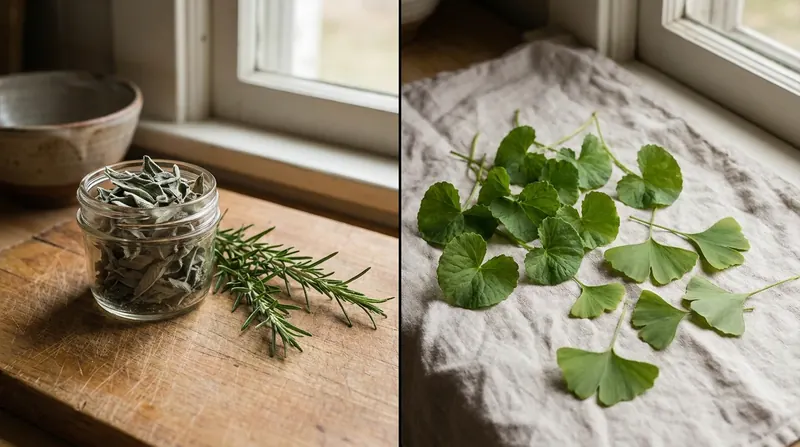
It's five plants: two from the kitchen, two from the far side of the world, and one from a North American meadow.
What does the label say the bottle is for?
The front says "Brain & Memory" and "Nervous System."
The seller's page says it supports healthy brain function, memory and concentration, with the little asterisk that means the FDA hasn't evaluated that sentence.
Does the label say what each plant weighs?
No. It gives one number for the whole blend, and one number for how much plant went into it.
You already know that second number. Ninety-one milligrams of dried herb per squeeze.
Why liquid, and not a capsule?
That's how this company has worked since 1979.
Alcohol pulls things out of a leaf that water doesn't, and a squeeze in a glass of water gives you a small thing to do twice a day.
So that's the offer.
Now let's take the five plants one at a time, in the order the label prints them, and see what the research actually used.
Gotu Kola: The Herb That's Probably Most of the Bottle, and One Small Trial
First on the label, and the one with the most careful thing I can say about it.
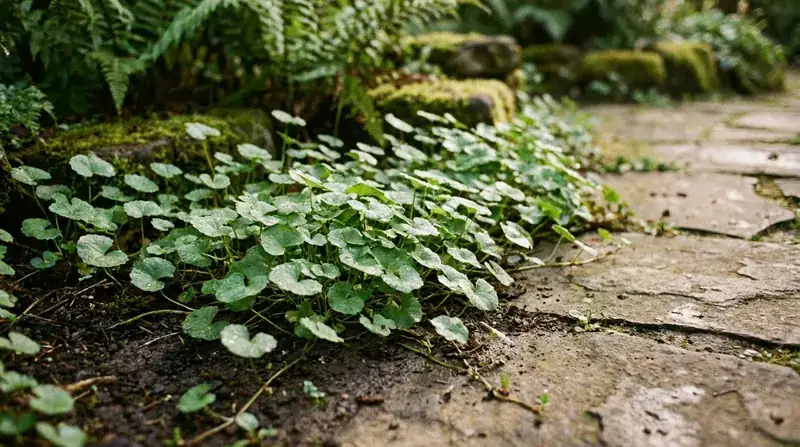
Gotu kola is a small creeping plant of wet ground across Asia, with round, scalloped leaves.
It's eaten as a green in Sri Lanka and used in Ayurvedic practice for the mind and for the skin.
On a label, the biggest share comes first.
So gotu kola is probably most of the bottle, and rosemary, last in line, is probably the least.
There's one trial in people your age, and it's small.
Twenty-eight healthy adults in their sixties took a gotu kola extract or a placebo for two months.
At the highest dose, 750 milligrams a day, they did better on a working-memory task and rated themselves more alert.
At the lower doses, less. [2]
A 2017 review pooled the trials that exist.
Across them, gotu kola didn't move cognitive test scores compared with placebo. [3]
What it did move, consistently, was how alert people said they felt.
Keep that word, alertness. It comes back in the reviews.
Seven hundred fifty milligrams of one plant's extract, every day, for two months.
This bottle's whole day, all five plants, is made from 273 milligrams of dried herb.
Ginkgo: The Famous One, and the Six-Year Trial
Second on the label, and the plant everyone has heard of.

Ginkgo has the biggest trial on this page, and it's the one that decides how to read the name on the bottle.
Three thousand and sixty-nine adults aged 72 to 96 took a standardized extract, 120 milligrams twice a day, or a placebo, for a median of six years.
At the end, the ginkgo group and the placebo group looked the same, in memory and in everything else measured. [4]
The National Institutes of Health says there's no conclusive evidence ginkgo helps with any health condition. [5]
There's a smaller, kinder study.
Ninety-three healthy adults aged 55 to 79 took 120 milligrams a day for twelve weeks.
On one kind of memory test, learning paired words, the ginkgo group did moderately better.
On the rest, nothing. [6]
Two hundred forty milligrams a day of standardized extract, for six years, moved nothing.
This bottle carries a share of 91 milligrams of dried leaf per squeeze, unstandardized.
And one caution, which doesn't shrink with the dose as much as you'd like.
Ginkgo can add to the effect of some things people take every day.
If you take anything daily, or you have a procedure coming, show the label to your pharmacist before the first squeeze.
It's a two-minute question at the counter.

Skullcap: A Traditional Meadow Herb, Put In Fresh, With a Study About How People Felt
Third on the label, and the one I had to read most carefully.

Skullcap is a slender North American plant of wet meadows, with small blue flowers along one side of the stem.
Old American herbals list it as a nerve herb, and Herb Pharm puts it into this bottle fresh, not dried.
It has one modern study, and it isn't about memory.
Forty-three healthy adults took 350 milligrams three times a day, or a placebo, for two weeks each.
On a questionnaire about how they'd felt over the fortnight, the skullcap weeks scored a little better.
Nothing about recall, attention or thinking speed was measured. [7]
A thousand and fifty milligrams a day of one herb, for two weeks, to move a questionnaire.
The bottle carries a fraction of 91 milligrams of dried herb per squeeze.
I can't turn skullcap into a memory claim, and neither can the label. It isn't there for that.
Sage: The Kitchen Herb With the Best Single Day in the Data
Fourth on the label, and the one you already own.
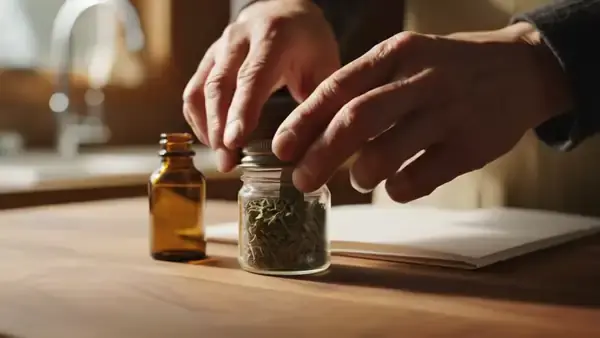
Sage is the gray-green, velvety herb in the jar next to the thyme.
It makes stuffing taste like Thanksgiving and sausage taste like breakfast.
European herbalists have used the leaf for a sore mouth and a queasy stomach for centuries.
Memory isn't on that traditional list.
But sage has a good trial in people your age, and it's the best single day on this page.
Twenty healthy adults over 65, average age 73, in a five-way crossover.
Each person tried four doses of a standardized sage leaf extract and a placebo, on different days.
On the 333-milligram day, they did better across the day on a measure of secondary memory and were more accurate on attention tasks than on the placebo day.
The other doses helped less, and the effect wasn't a straight line with the dose. [8]
There's a younger trial too.
Thirty healthy young adults took single doses of 300 and 600 milligrams of dried sage leaf.
At 600 milligrams they did better on a multitasking battery.
The lower dose actually made them less alert during the task. [9]
Three hundred thirty-three milligrams of sage extract, once, in adults over 65. Or 300 to 600 milligrams of dried leaf, once.
Half a teaspoon from your jar is 350 milligrams of dried leaf. This bottle's whole day is 273, split five ways.
That's the line I wrote in the notebook and underlined.
If sage is the herb you're buying this bottle for, the jar on your shelf carries more of it than the bottle does.
Two cautions, and I'd rather you heard them from me.
Cooking with sage is an everyday thing, and has been for centuries.
The leaf contains thujone, and the European herbal monograph says sage oil equal to a large amount of leaf can bring on heat, a racing heart and dizziness.
It also says its use in pregnancy hasn't been studied enough.
A squeeze in water is nowhere near that amount.
It's still a reason to ask, if you're pregnant or you take anything daily.
Rosemary: The Herb Where a Pinch Did Better Than a Handful
Last on the label, and probably the least of the five.
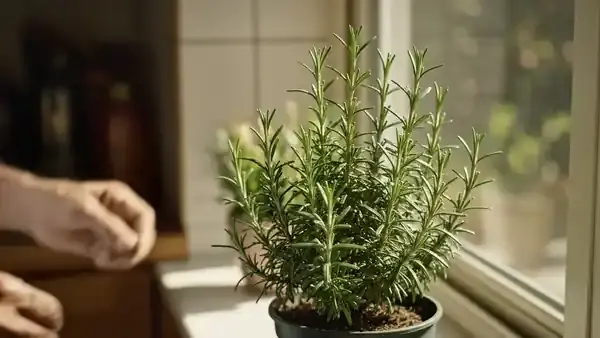
Rosemary is the needle-leaved bush by every Mediterranean door, and the herb on your roast potatoes.
Herb Pharm puts the leafy tips in fresh.
It has one trial in people your age, and the shape of the result is the interesting part.
Twenty-eight adults, average age 75, took single doses of dried rosemary leaf on different days.
At 750 milligrams, about what you'd put on a tray of potatoes, their speed of memory was faster than on placebo.
At 6,000 milligrams, a handful, it went the other way, and other measures got worse. [10]
Seven hundred fifty milligrams of dried rosemary, once, helped. Six thousand hurt.
The bottle carries the smallest share of 91 milligrams of dried herb per squeeze.
So the honest reading of rosemary is a small single-day effect at a kitchen amount.
And a reminder that more isn't better, which is worth remembering about every plant on this label.
What the Studies Actually Measured, Put Plainly
Let's step back from the five plants for a minute.
If you squint at all those trials together, what did anybody actually see?
Did anyone test this blend?
No. Nobody has put this five-herb extract, at this amount, in front of a group of people and a placebo.
Everything below is about the single plants, at their own doses.
So what did the single-plant studies look at?
Four kinds of things, and it helps to keep them apart.
- How alert people said they felt. Gotu kola moved this in its small trial and, more steadily, across the pooled review. [2] [3]
- Secondary memory and attention accuracy, over one day, after one dose. That's sage at 333 milligrams in adults over 65. [8]
- Speed of memory, one day, one dose. That's rosemary at a kitchen amount, and only at the small dose. [10]
- Learning paired words, over twelve weeks. That's ginkgo in adults 55 to 79, on one test out of many. [6]
Now the list of what didn't move.
Ginkgo over six years, [4] and gotu kola's test scores, pooled. [3]
Rosemary at a handful. [10]
So the fair summary is "some single plants, at trial doses, nudged a feeling of alertness or one kind of test on one day."
That's what's been studied. It isn't a promise, and it isn't what a squeeze is sure to do for you.
Then why would anyone buy it?
Good question, and you'll get a straight answer.
Some men like a real plant ritual with a label they can read, and a reason to stop twice a day for a glass of water.
We'll get to the water. It matters more than you'd think.
How to Read a Label That Gives You One Number
Here's a skill that'll serve you long after this page, whatever you end up buying.
A lot of herbal labels list several plants and then print a single number for the whole lot.
You'll see "proprietary blend" or "extract blend," and then one figure in milligrams.
What does that one number hide?
It hides the split.
You know the total, but you don't know whether gotu kola is nine-tenths of it or half of it.
And what does a liquid number hide?
The weight of the liquid.
Alcohol and water weigh something, so a big milligram figure on an extract isn't the same as a big milligram figure of plant.
So what do you look for?
The extraction rate, or anything that says how much plant went in.
On this bottle it's printed, which is to Herb Pharm's credit, and plenty of labels don't bother.
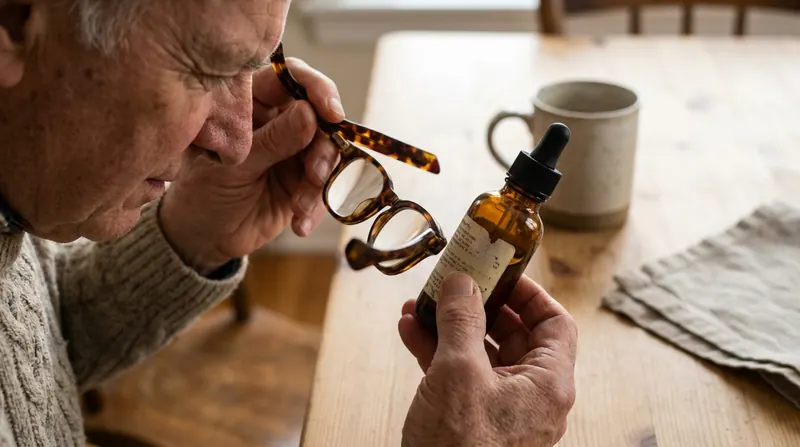
The small print is where a label tells you what you're actually getting. The big print is where it tells you what to feel about it.
Now let's put that small print on this bottle to work.
What 646 Milligrams of Extract Is Made From
Let me show you the arithmetic, because the arithmetic is the product.
The Supplement Facts panel gives one figure for the blend: 646 milligrams of certified organic extract per 0.7-milliliter squeeze.
That sounds like a lot of herb. It isn't.
It's the weight of the liquid, alcohol and water included.
The line underneath is the one that counts: that liquid was made from 173 milligrams of fresh herb, or 91 milligrams of dried.
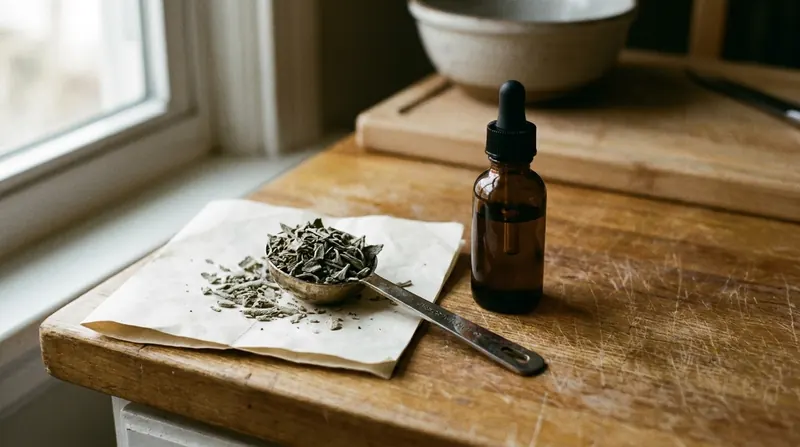
So here's the day, at the label's maximum of three squeezes.
Two hundred seventy-three milligrams of dried herb, shared by five plants.
Now the teaspoon.
The U.S. Department of Agriculture's food tables put a teaspoon of ground sage at 0.7 grams, which is 700 milligrams. [1]
Half a teaspoon is 350.
A day of this bottle is made from less dried herb than half a teaspoon from the sage jar.
And the half-teaspoon is one plant, while the bottle's share is split five ways.
I don't say that to sneer at it. Extracts are how herbalists have worked for a very long time.
I say it because the trials above are measured in hundreds of milligrams of one plant at a time, and you should know what "hundreds" means here.
Every plant in this bottle has been studied. None of them has been studied at the amount that's in a squeeze.
One Ounce, Five Names, and a Rubber Bulb
Now that you know what's inside, here's what's on the counter.
A bottle short enough to stand in a coat pocket. A black bulb on top.
An orange label with a blue panel that says Brain & Memory, then Nervous System.
How do you take it?
The label says to shake it, then add one squeeze of the bulb to two ounces of water or juice, two or three times a day, best between meals.
One squeeze is 0.7 milliliters. Every number on this page is for that squeeze.
What else is on the label?
It's made with certified organic cane alcohol, 56 to 66 percent, plus distilled water and organic vegetable glycerin.
And the cautions are short: seek expert advice before taking it in pregnancy, keep it away from children, store it away from heat and light.
That's the bottle. Now a few plain questions I asked it.
Questions I Put to the Label and the Seller's Page
Before I spend a dollar, I ask the bottle a few plain questions.
Here are the answers, straight from the label and the seller's own pages.

Where do the plants come from?
The label prints "Williams, OR," the company's original home and farm, and the contact page gives an address in Central Point.
Every plant on the panel is marked certified organic.
That's a farming claim, and a checkable one.
Why are two of them put in fresh?
Skullcap and rosemary go in undried, according to the label.
That's why the panel gives two numbers, 173 milligrams of fresh herb and 91 of dried: a fresh plant carries its own water.
Why does it say "shake well"?
Plant extracts settle, and each squeeze should carry the same share.
Give it a couple of shakes before the bulb, every time.
How long does a bottle really last?
One of the seller's pictures says "up to ~3 week supply," and another says to take it up to three times a day.
Both are true, just not together.
Three a day is two weeks; two a day is three.
Is there a bigger size?
Yes, a four-ounce bottle.
I'd still start with the one-ounce, and I'll tell you why further down.
What else does the listing say about it?
No gluten, vegan, non-GMO, and an "Identity Verified" seal about checking which plant is which.
Those are about how it's made. None of them is about what it does.
Can I call someone?
Yes. The order line is 800-348-4372, and there's an information line at 541-846-6262, weekdays from 7 to 4:30 Pacific time.
A real phone with a real person on it is worth more to me than any seal on the box.
One more thing about the bottle, and it's the part you'll taste first.
It's an Alcohol Extract, and I'd Rather Tell You Than Have You Find Out
The label says certified organic cane alcohol, 56 to 66 percent, with distilled water and organic vegetable glycerin.
A 0.7-milliliter squeeze is therefore about 0.4 milliliters of alcohol.
That's less than a sip of wine, and in two ounces of water it's a trace.
Three squeezes a day come to about 1.2 milliliters, roughly a fifteenth of an ordinary glass of wine.
But it's alcohol.
If you avoid it for any reason, on principle, in recovery, or because of something you take daily, you now know.
The seller makes some of its other extracts without it. This one has it.
The alcohol also explains the taste.
Bitter, green, warming in the throat, gone in a moment.
The seller's own page calls the flavor "somewhat bitter with a hint of Rosemary," which is fair.
Nobody in 23 reviews complained about the taste, and several mentioned the water. That's the right way round.
An Ordinary Tuesday With the Bottle on the Counter
So what would it actually look like, living with this thing?
Let me walk you through a plain Tuesday, the way I'd set it up if I bought one.
Seven o'clock.
Coffee, same as always. The bottle stays in the cupboard; the label says between meals, and breakfast is a meal.
Half past ten.
This is the first squeeze. Two ounces of water in a short glass, shake the bottle, one squeeze of the bulb, stir, drink it standing at the counter.
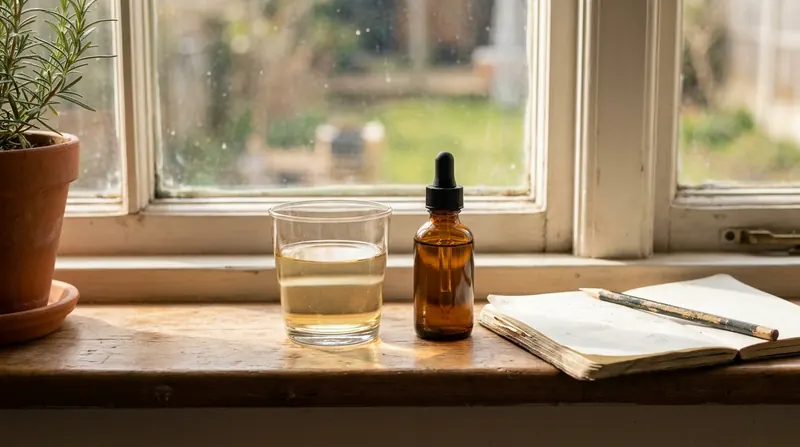
Then one line in the notebook.
Not "sharper" or "foggier." Just what you're about to do, and how the last hour went.
Noon.
Lunch, and a proper glass of water with it. You'd be surprised how many of us go till supper on coffee alone.
There's a reason I keep coming back to water.
In a Berlin study of 1,111 adults aged 60 to 89, the ones who were measurably short of water did worse over time on a test of processing speed. [11]
A 2021 review of the research in older adults found the link to thinking is real but thinly studied. [12]
So I won't oversell it. But water is the cheapest thing on this whole page.
Three o'clock.
The second squeeze, in place of the fourth coffee.

That swap is half the point.
You get a small pause, a glass of water, and no caffeine at the hour when caffeine starts borrowing from tonight.
Four o'clock.
A walk around the block, or out to the mailbox and back the long way.

Evening.
If you take a third squeeze, it's after supper, well before bed, and that's the last of it.
Then another line in the notebook.
Is that really all there is to it?
That's all. Two or three small stops a day, a lot more water than you're drinking now, and a notebook that keeps you honest.
The bottle is the smallest part of that day. The habits around it are the biggest.
Why a Man Feels Sharper Mid-Morning, and What Else Does the Same Job at No Charge
Suppose you buy it, squeeze it into water at ten, and feel a little clearer by half past.
I'd believe you. And I'd give you three reasons before I gave the herbs one.
You drank two ounces of water, maybe four, at an hour you'd normally have poured coffee.
You stopped for thirty seconds, shook a bottle, counted a squeeze, stirred a glass. A small ceremony wakes a man up.
You tasted something bitter and green.
Bitterness on the tongue does what a mint does, for a minute.
None of that is in the plants. All of it comes with the bottle.

What actually helps, and costs nothing, is dull.
- Water mid-morning and mid-afternoon, at the hours you'd have poured a third and fourth coffee.
- No coffee after two. The three o'clock cup buys you three o'clock and costs you eleven.
- One thing at a time. Radio off while you read the manual.
- Ten minutes outside before the hard part of the day. Under a tree, if there's one.
- A notebook. Writing a thing down is the oldest memory aid there is, and it never runs out.
Now look at that list and be honest.
You've heard every item since your first physical, and you still don't bother with most of them.
Boring loses to coffee every time.
If an amber bottle gets you to drink two glasses of water and take two pauses a day, it did its work before any herb did.
What Your Own Kitchen Already Does With Two of These Plants
Here's the part of this page nobody can put a price on.
Two of the five plants are sitting in your spice rack right now.
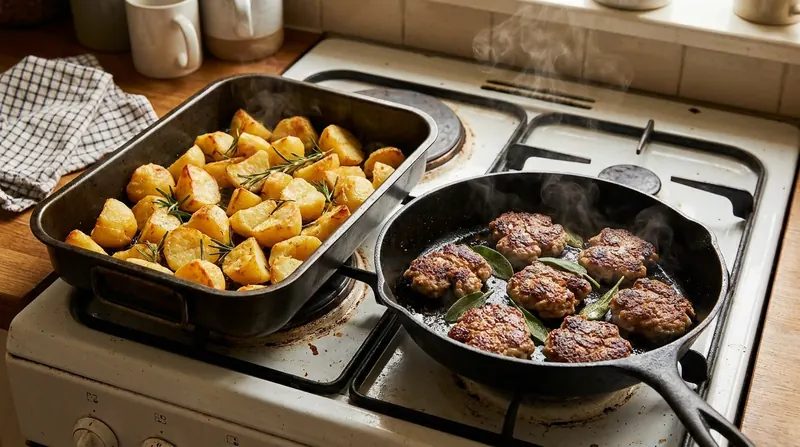
The rosemary study used 750 milligrams of dried leaf, about what goes on a tray of potatoes. [10]
That trial measured one afternoon, not a lifetime of Sunday dinners, so don't read a roast as a memory plan.
But you can see the point.
A pinch in the pan is a kitchen amount, and the kitchen amount was the one that helped on that single day.
Sage is the same story.
Half a teaspoon in the stuffing, or in browned butter over squash, is 350 milligrams of dried leaf, more than the bottle's whole day. [1]
So should I just cook with sage instead?
Cook with it because it tastes good. That's reason enough.
Just know that no trial has tested a pan of stuffing, and I won't pretend one has.
Then what's the bottle for, if the jar holds more?
Two things the jar doesn't give you: the other three plants, and a small ritual in a glass of water twice a day.
If the jar and the bottle both end up on your counter, that's a well-stocked kitchen, not a contradiction.
Who It Suits, and Who It Doesn't
This is worth a look if:
- You like real plants at kitchen amounts and you've now seen exactly how much that is.
- You want the whole label, a company with a street address, a phone number that answers in Oregon, and a 30-day credit policy. You have all four now.
- You can hold two ideas at once: five herbs with real trials, at amounts far below the trials.
- You'll run it as a fourteen-day test with a notebook, not as a hope.
- You don't mind alcohol in trace amounts, and you don't mind bitter.
Give it a miss if:
- You want a trial dose of gotu kola, sage or anything else. Buy the plant, or an extract with milligrams per herb on the label.
- You want something made for a health condition. This is a food supplement, and its label carries the sentence that says so.
- You avoid alcohol entirely, for any reason. There's alcohol in every squeeze.
- You take anything daily, or you have a procedure coming. Ginkgo is on the label, so ask your pharmacist first.
- You're pregnant or nursing. The label says to seek expert advice first, and sage's monograph says the same.
- You want cash back if it doesn't suit you. The policy is credit or exchange.
Which list are you on?
If you're on the second one, close the page and keep your money. I mean that kindly.
If you're on the first list, here's the kind of man I picture using this bottle well.
He keeps a pocket notebook, he's curious about plants, and he likes a small routine he can stick to.
He isn't expecting a new memory by Friday.
He's expecting two glasses of water, two pauses and fourteen honest lines, and he'll get all three.
Three Fair Objections: The Price, the Taste and the Time
If you're still reading, you've probably got at least one of these in your head already.
Let's take them in order.
"It's a lot of money for an ounce of liquid."
Fair. The price is on the seller's page, not here, and it changes.
What I can tell you is what you're paying for: organic plants, a small farm, a company that's been doing this since 1979, and a label that tells you the extraction rate instead of hiding behind a big number.
And one bottle is the smallest honest test there is.
Fourteen days at three a day, three weeks at two.
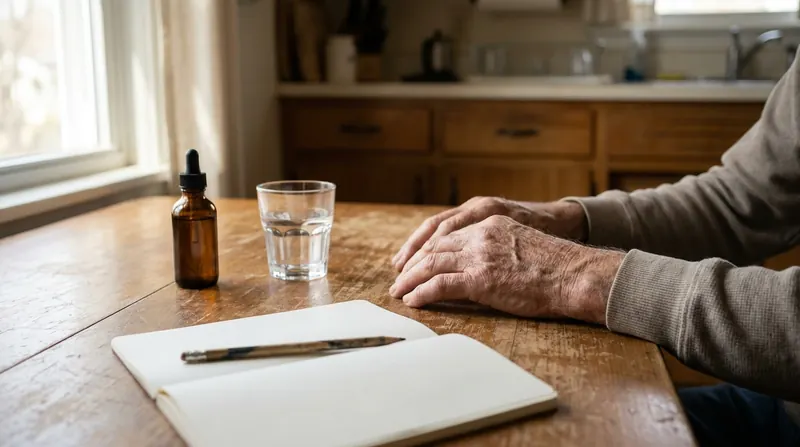
"I don't like the taste of anything herbal."
Then take it in juice, which the label allows, or in a bigger glass of water.
It's bitter for a moment and then it's gone. Nobody in the reviews called it pleasant, and nobody called it a problem either.
"How long before I'd notice anything?"
Honestly, maybe never, and I'd rather you went in knowing that.
The single-dose trials looked at the same day; the others ran twelve weeks, two months, six years.
Kim, one of the customers you'll meet below, wrote after one week that it was "not enough to measure."
Sean wrote after a year of using it on and off. Those are the two ends of the calendar.
"I already take a handful of things every morning."
Then this is the one to talk over before you add it, not after.
Ginkgo, sage and the alcohol base are the three questions to ask.
Put everything you take in one bag, this bottle included, and take it to the pharmacist.
It costs nothing, and it's the best two minutes you'll spend on this whole project.
Six Things a Squeeze of This Won't Do
- It won't give you a trial dose of any of its five plants. The label makes a squeeze from 91 milligrams of dried herb, shared five ways.
- It isn't made for any health condition. It's a herbal supplement, and its own label carries the sentence that says so.
- It won't be without alcohol. Every squeeze is about 0.4 milliliters of cane alcohol, diluted in your glass.
- It won't taste like anything but herbs in alcohol. Nobody complained, but nobody called it pleasant either.
- It won't last a month at the label's maximum. Forty-two squeezes at three a day is fourteen days.
- It won't come back as cash. The seller's policy is a credit or an exchange, requested within 30 days, with an authorization number first.
If that list annoys you, I'd rather you were annoyed now than when the box arrives from Oregon.
If You Do Buy It: One Bottle, Two Weeks, Two Glasses of Water, One Question
If you're going to spend the money, spend it as a test with a date on it.
And test the thing that can actually work.

- Buy one bottle, the one-ounce. Not the four-ounce, whatever the per-ounce price says.
- Squeeze it into two ounces of water at half past ten and at three, between meals. Two a day, so the bottle lasts three weeks and you can see a pattern.
- Nothing after two but water. The bottle has no caffeine; make the afternoon match it.
- Write one line a day in a notebook. What you were doing at three, and how it went.
- Keep the coffee where it is for the first week, so you know what the bottle does. Cut the afternoon cup in the second, so you know what the water does.
- On the last day, read the lines. The notebook will tell you more than the bottle will.
Look at that list the way I do.
Four of the six things cost nothing.
The bottle is the one you'll pay for.
The water and the notebook are the ones most likely to do the work.
How to Read Your Own Notebook on the Last Day
Fourteen lines, or twenty-one if you went two a day.
Here's how I'd read them, at the kitchen table with a cup of coffee before noon.
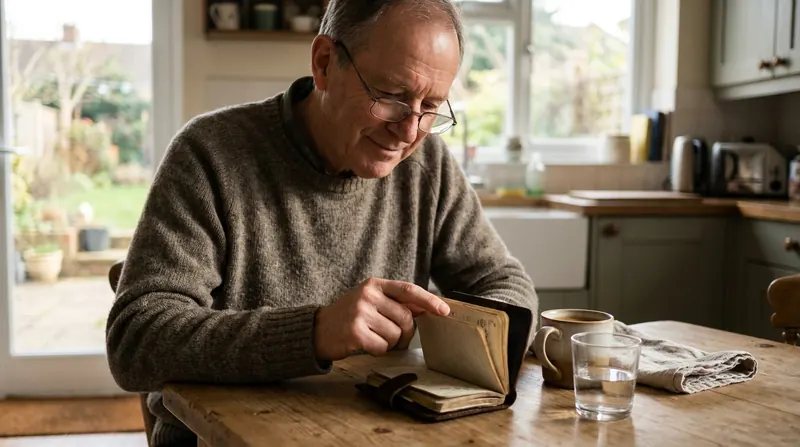
First, read week one against week two.
Week one had the bottle and the usual coffee. Week two had the bottle and less afternoon coffee.
If week two reads better, the likeliest reason is the coffee you didn't drink and the water you did.
That's good news, because it's a change that costs nothing.
Second, count the three o'clock lines.
Three o'clock is where most of us fade.
If those lines got steadier, notice what else changed at three: the glass, the pause, the walk.
Give each of them its share of the credit.
Third, look at the bad days.
Everybody has them: a short night, a long drive, a loud room.
If the bad days line up with short nights, you've learned something about your nights, not about the bottle.
Fourth, be fair to the bottle.
If you honestly can't tell the two weeks apart, that's an answer too.
Stop, keep the habits, and put the money toward something else.
No hard feelings on either side.
And if you liked it?
Then you liked a ritual with real plants in it, at kitchen amounts.
That's allowed. Just order the next bottle knowing exactly what it is.
The notebook doesn't flatter anybody, which is why I trust it.
From Southern Oregon, by UPS, With a 30-Day Credit Policy
The bottle is sold by Herb Pharm on its own website, and that's the only place this page links to.

The company is easy to find.
Herb Pharm, LLC, with its address in Central Point, Oregon, and a farm in Williams printed on the label.
There's a phone number that answers on weekdays and an email on the contact page.
It's been making liquid extracts since 1979, certified organic, and it says so on every bottle.
What does it cost?
The current price is shown on its page, not here.
The day I read it, one bottle came in under the seller's shipping threshold, so expect a shipping charge on a single bottle.
Buy one anyway: fourteen days is a test. Four ounces of something you haven't tried is a bet.
How does it ship?
Within the United States by UPS, including Hawaii and Alaska, and not abroad.
Orders are prepared within three business days and arrive in three to eight days all told.
And if you don't like it?
You tell the seller within 30 days of purchase and ask for a return authorization number.
What you get back is a full credit toward another order, or an exchange.
The policy doesn't mention cash coming back, so don't expect it.
Damage gets reported at once; anything missing from the box, within seven days.
It's a fair policy for a small bottle of herbs. It isn't cash back, and I'd rather say so than have you find out.
One amber ounce, sent from Oregon
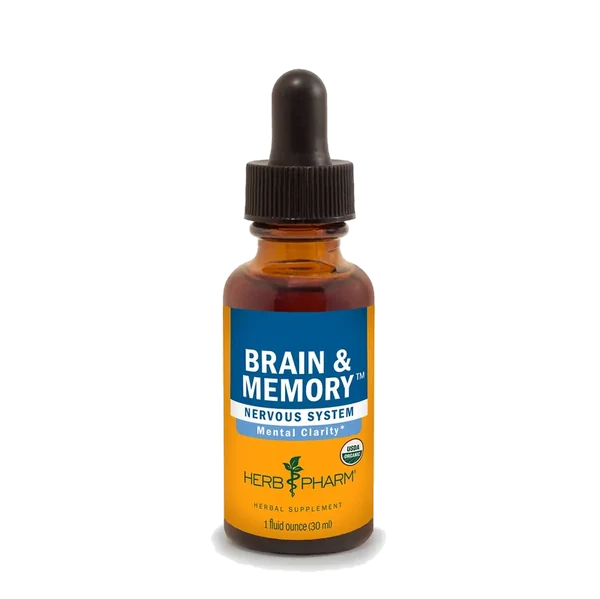
A certified-organic liquid extract of five herbs (gotu kola, ginkgo, skullcap, sage and rosemary) in cane alcohol, water and glycerin, taken as one squeeze of the bulb in two ounces of water, two or three times a day.
SEE THE ONE-OUNCE BOTTLESold and shipped by Herb Pharm, LLC, Central Point, Oregon, by UPS within the United States · a single bottle is below the seller's shipping threshold · 30 days to ask for a credit or exchange, with a return authorization number first
Twenty-Three Reviews, Read All the Way Down, and Five Kept
The seller's page shows 23 reviews with an average of 4.8.
Twenty gave five stars, two gave four, one gave three.
Its review system marks 21 of them as confirmed purchases. I read every one.
Then I set aside more than half, and I'll tell you which.
I set aside one written in a professional health role, because a credential doesn't belong on a page like this.
I set aside the one that compared the bottle with tablets, and the one that credited it with something the label doesn't claim.
I set aside two that recounted memory gains after a specific problem, because I can't check them and neither can you.
I set aside three that were only about the box arriving, or not arriving, and two more that used a word for the bottle I've promised not to use here.
What's left is the modest middle, which is where the truth usually lives.
These are real customers, quoted word for word from the seller's review system; the small photos beside them are illustrations, not the reviewers.

I think it works.

I'm just now beginning to recognize some improvement in my memory (not enough to measure at this time), it's only been a week since I've been taking this supplement, as they do not produce immediate results, effects typically take several weeks with consistent daily use, but I'm hopeful and have experience great results with one other product; the 4 star is my belief that this supplement will soon show more positive effects, I've ordered more to continue, because one bottle won't do it

I was skeptical, but after using this on and off for the past year, I am 1000% in! This stuff works - at least it does for me. I take it with my vitamins each morning. Everything seems more clear, and work comes easier. It's noticeable when I forget to take it for a few days.

We are pleased with trying this out. Hoping that the four ounce is available soon. My wife and I are both using this. At 71 and 72, we figure 'what have we got to lose'?
I like to take this before teaching a class to help me feel focused and sharp.
Read those the way I did.
Gerry gave it five stars and four words, and the second word is "think." I trust him more for it.
Kim gave it four, wrote "not enough to measure," and ordered more anyway. That's an honest tester.
Sean says "at least it does for me," which is the most careful sentence in the pile.
Then he says he notices when he skips it.
Kenneth and his wife, at 71 and 72, are running it as a test with nothing much to lose. So should you.
Kristen takes it before a class. That's a ritual, and rituals are real.
Nobody I kept claims anything big. Several describe feeling more alert, which is the effect the gotu kola review found, and the one I believe in.
Short answers before your first bottle
Is this medicine?
No. It's an herbal supplement, a liquid extract of five plants in cane alcohol, made in Oregon.
What does "91 mg dry herb per 0.7 ml" mean?
Each squeeze was made from 91 milligrams of dried plant, shared by all five herbs. Half a teaspoon of dried sage is about 350.
Does it have caffeine or sugar?
Neither. It has cane alcohol, about 0.4 milliliters per squeeze, diluted in your glass.
What does it taste like?
Bitter, green and a little warming, gone in a moment. The seller calls it "somewhat bitter with a hint of Rosemary."
How long does a bottle last?
About 42 squeezes: fourteen days at three a day, three weeks at two.
Will it help my memory?
I can't tell you that, and be wary of any page that does. The trials used far more of each plant than a squeeze holds.
Can I take it alongside what I already take?
Show the label to your pharmacist first. Ginkgo, sage and the alcohol base are the three things to ask about.
Does it ship to me?
Within the United States by UPS, including Hawaii and Alaska. Not abroad.
What if I don't like it?
Tell the seller within 30 days and get a return authorization number. You'll receive a credit or an exchange, not cash.
Why not the four-ounce bottle?
Because you haven't tried it yet. Let fourteen days and a notebook decide.
Everything Above, in Sixty Seconds
- A one-ounce amber bottle of certified-organic liquid extract from Herb Pharm, LLC, of southern Oregon: gotu kola, ginkgo, skullcap, sage and rosemary.
- One squeeze in two ounces of water, two or three times a day, between meals. About 42 squeezes to the bottle.
- Each squeeze is made from 91 milligrams of dried herb, shared by five plants. Half a teaspoon of dried sage is 350. [1]
- Gotu kola has one small trial at 750 milligrams a day. [2] Ginkgo showed no difference over six years at 240. [4]
- Sage has one good day at 333. [8] Rosemary helped at 750 and hurt at 6,000. [10] Skullcap's study was about how people felt. [7]
- About 0.4 milliliters of alcohol per squeeze. No caffeine, no sugar.
- Twenty-three reviews, average 4.8; the five I kept say "I think," "not enough to measure" and "at least it does for me."
- Ships within the US by UPS; 30-day credit or exchange, not cash back.
- The honest use: two glasses of water and two pauses a day, with a real herb ritual attached.
What a Squeeze Is Actually Worth
Here's the whole thing in one breath.
Five real plants, organically grown on a farm in Oregon, pulled into alcohol and water.
Ninety-one milligrams of dried herb to the squeeze, less than half a teaspoon of sage to the day.
Trials behind every one of them, all at doses the bottle doesn't reach.
And 23 customers, the best of whom say "I think it works" and mean exactly that.
If you're a man who wants an herb ritual with a real label behind it, and two more glasses of water than you drink now, that's worth a fourteen-day test.
Not because of what's in the squeeze. Because of what you'll do around it.
Buy one bottle, not four, and let the notebook be the judge.
The five plants on the label, in the order it prints them, with what each one is, what the research used and the cautions for each, are written out in the ingredient guide linked at the foot of this page.
Print it and take it to the pharmacist if you take anything daily. It's written for that.
Herb Pharm, LLC · 800-348-4372 · [email protected] · 30 days for a credit or exchange
P.S. If you take one thing from this page, take the two numbers.
Ninety-one milligrams of dried herb per squeeze, shared by five plants. Three hundred fifty milligrams in half a teaspoon of sage from your own jar.
P.P.S. If the afternoon fog has been with you for a year, and it's there in the morning too, talk to your own clinician before you buy anything.
A squeeze in a glass of water is a small habit. It was never going to answer a question a clinician answers in fifteen minutes.
P.P.P.S. And if you do order it, keep the notebook.
When the bottle is empty, you'll have fourteen lines about your own afternoons, and that's worth more than the bottle, whichever way the lines turn out.